
Delegating decisions only works when leaders are coached to make them. This edition looks at the difference between access and dependence, what McKinsey's research says about deciding at the right level, and how to coach a decision without taking it.
You hired capable people because you wanted them to lead. You gave them titles, budgets, and teams. Yet when a hard call comes up, they come to you, and you help them think it through. You offer the answer you would have chosen, they leave relieved, and you leave feeling useful.
A month later, a similar question returns, sometimes from the same person. Your calendar fills with conversations like this one, and the decisions that only you can make get less of your attention.
Nobody in this exchange is doing anything wrong. Your team values your experience, and they should. The better question is whether your help is building their judgment or taking its place. That question sits at the center of delegating decisions well.
What the research says about delegating decisions
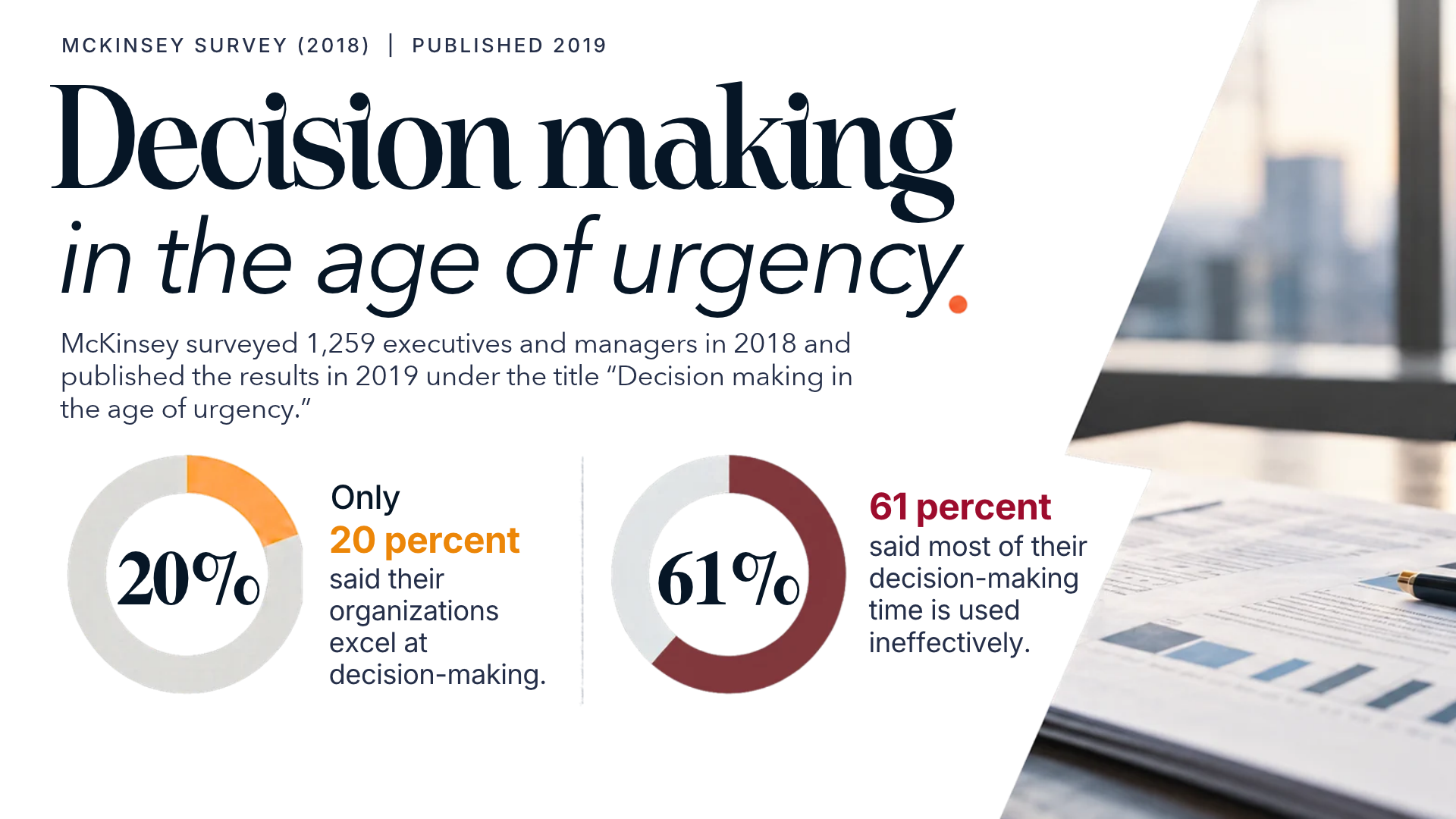
McKinsey surveyed 1,259 executives and managers in 2018 and published the results in 2019 under the title “Decision making in the age of urgency.” Only 20 percent said their organizations excel at decision making. In the same survey, 61 percent said most of their decision-making time is used ineffectively. Those numbers describe a frustration most executives will recognize.
The finding that matters for a CEO is about where decisions get made. Respondents who said decisions in their company are made at the right level were 6.8 times more likely to work at a winning organization. McKinsey notes that this often means delegating decisions downward. McKinsey defined winners as companies that make high-quality decisions fast, execute quickly, and show better growth or returns than their peers.
A second finding is more specific. Organizations that coached people and gave them room to fail safely had 3.9 times the odds of winning. Neither half works alone. Coaching with no room to act produces polite rehearsals, and room to act with no coaching produces expensive guesses.
This is survey data on how executives perceive their organizations, so it shows an association and not a cause. It still points to a role for the CEO that sits between answering every question and walking away.
Access and dependence look alike from the CEO's chair
An accessible CEO makes it easy for leaders to ask thoughtful questions and surface risks early. A dependent organization requires those leaders to get the CEO's approval or answer before they take a reasonable action.
From where you sit, the two can look identical. Both involve conversations, collaboration, and working through challenges. The difference shows up in who leaves the conversation holding the decision, and who is better prepared to make the next one.
If you routinely settle every dilemma, your team learns that the safest answer is yours. People get skilled at predicting what you would say, and they use that skill in place of the principles, objectives, and information already available to them.
Delegating decisions is not the same as delegating tasks
Task delegation sounds like this: “Prepare the proposal and bring it to me for approval.” Leadership delegation sounds different: “You own the client proposal process for this category of work. Here are the outcomes, the budget limits, and the situations that need to come to me.”
Both have a place. High-stakes or legally sensitive decisions may need explicit CEO sign-off. When all work is treated as high stakes, the organization cannot move at the pace its people can sustain.
Decision authority has to be specific. What does this leader decide alone? When do they consult peers? What must be escalated? What results will tell us the decision was sound? Without those answers, “take ownership” is an instruction with nothing behind it.
Why the CEO keeps stepping in
Sometimes it is about quality. You know what good work looks like and can get there fast. Sometimes it comes from experience, because a past mistake made you slow to allow the next one. Sometimes it is about identity. For years your value showed up in knowing the answer and saving the day.
As the business grows, that identity gets uncomfortable. A strong leadership team may not need you in the issues that once defined your contribution. That is evidence the organization has developed.
It still takes discernment. If a leader lacks the skill, handing over authority without support sets them up to fail in ways the business cannot absorb. If the process is poorly defined, delegation only passes the confusion along. McKinsey's pairing of coaching with room to fail safely makes the same point: development, authority, and accountability have to grow together.
Coaching a decision without taking it
Change the first question you ask. Instead of “Here's what I would do,” try “What's your recommendation?” Then ask which options they considered and what risks they see. Ask what would cause them to revisit the decision.
Agree on the boundaries and let them act. Afterward, look at how the decision was made as well as how it turned out. A thoughtful decision can produce a disappointing result, and a weak one can occasionally work. Your team needs to learn to tell the difference.
Through the People lens, this builds capability. Through the Communication lens, it makes recommendations and expectations clearer. Through the Systems lens, it gives authority a structure that does not depend on personalities or informal permission.
The Friction Point
If your team can lead only when you are supplying the answers, the organization is running on borrowed judgment. Being needed feels productive. Delegating decisions with clear limits, and coaching the judgment behind them, lets the business grow past your calendar.
Two Moves This Week
Start delegating decisions in one category, such as customer concessions or purchases under a certain amount. Write down the realistic worst outcome of a wrong call and what it would cost. Then agree with the leader who handles that category on a limit. Below it, they decide and tell you afterward. Above it, they bring you a recommendation first. Room to fail safely is a number and a rule, agreed on before anyone needs it.
Within a week of the next decision that leader makes under that limit, hold a fifteen-minute conversation. Ask what they weighed and what they would change next time, and say plainly what you saw in how they reasoned. If the result was poor but the thinking was sound, tell them so. If the result was good but the thinking was thin, tell them that too.
A CEO's influence should show up in the decisions they make and in the quality of the decisions other people learn to make.
Think about the last few times a leader brought you a decision. When the conversation ended, who was holding it?
The friction is where growth lives.

Amy K. Nunn is the founder of Next to Nunn and a leadership strategist who works with business owners, CEOs, executives, and leadership teams to identify the people, communication, and systems patterns slowing their organizations down.
Want The Leadership Friction delivered directly to your inbox each week? Subscribe through Next to Nunn. You can also browse every past edition, including You Might Be the Bottleneck, which looks at how decisions pile up on the CEO’s desk.
Ready to work through the friction in your organization?
Book a Strategy Call