
Picture a leadership meeting where the CEO presents a restructuring proposal. It combines two divisions and moves several decisions that used to belong to regional vice presidents. Within minutes, two executives push back. One questions the timeline, and the other says the analysis behind the proposal is incomplete. The CEO leaves the room convinced she has a resistance challenge on her team.
Both executives may have raised fair points about the timeline and the data. Each of them also heard something the CEO did not say. One heard that her team and her voice in the room were about to shrink, and the other heard that the rules for the coming year would change without anyone telling him what they would be. From the head of the table, this looks like resistance, while from the executives’ chairs it looks like a possible loss of authority and influence, along with certainty about what comes next. The challenge is that the CEO cannot easily tell which objections concern the proposal and which concern the proposal does to the person raising them.
The smoke alarm goes off before anyone checks for fire
Think about it this way. A smoke alarm responds to smoke, and it cannot tell you whether someone burned the toast or the kitchen is on fire. People can respond to perceived social threats similarly, reacting first and measuring the threat afterward. In a 2008 article in the NeuroLeadership Journal, David Rock, a co-founder of the NeuroLeadership Institute, described a framework called SCARF that draws on social neuroscience. He argued that the brain handles some social threats, such as a loss of standing, with systems that overlap with how it handles physical danger. He also argued that threat reduces the prefrontal resources people use for working memory and careful reasoning, which makes it harder to think well in the moment.
Some caution is in order. Rock presents SCARF as a model that summarizes existing research, and his article does not test the model itself. Some of the studies behind it were done on animals, and none were designed around executive teams. It works best as a source of better questions about what is happening in a meeting, and it does not tell you what any one person is feeling.
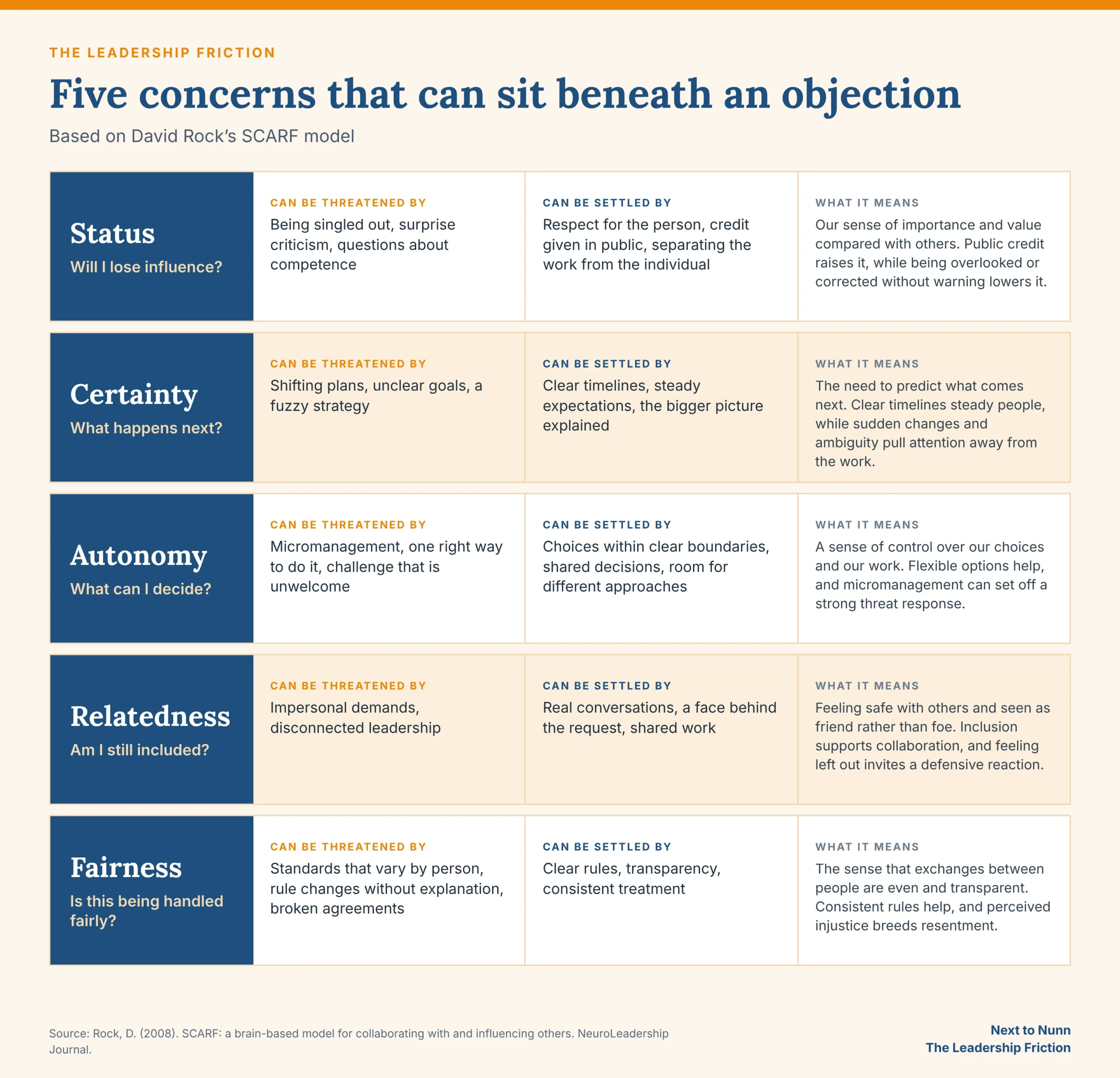
Five concerns that can sit beneath an objection
Rock’s five domains translate into questions that executives rarely ask directly in a leadership meeting. Status shows up as “Will I still have influence?” and certainty as “What happens next, and when will I know?” Autonomy is the question of what the person will still get to decide, while relatedness asks whether they remain part of the group that matters. Fairness asks whether the change is being handled evenly or whether some people are getting exceptions. Any one of these can turn a reasonable discussion about timing into a defense of position.
Unclear authority raises the threat
Concerns like these grow when the organization has not settled who decides what. Rock identifies unclear expectations as a source of certainty threat, and he writes that micromanagement produces a strong threat response around autonomy. When decision rights are vague, a proposal that moves authority arrives in a room where nobody is sure what the current rules are, so each executive has reason to protect whatever they can still count on.
Inconsistent expectations add a fairness concern. Suppose one executive misses a target and hears nothing, while another misses a similar target and has a direct conversation with the CEO. The team will conclude that the standard depends on the person, and Rock lists rules that appear to differ across people among the conditions that trigger a fairness response. Here is what I see in that pattern: when people cannot predict how authority and expectations will be applied, trust erodes, and an executive who cannot predict them will tend to defend a position instead of raising a concern.
Why this matters for working through the challenge
Harvard’s Amy Edmondson published a study in Administrative Science Quarterly in 1999 that examined 51 work teams in a manufacturing company. She defined team psychological safety as a shared belief that the team is safe for interpersonal risk-taking. Teams with higher psychological safety showed more learning behavior, and learning behavior was associated with performance ratings from outside observers. Team structures also mattered: context support was significantly associated with psychological safety, and team leader coaching came close to significance. The study used a single company and surveys taken at one point in time, so it shows an association and cannot show that safety causes learning.
The reason to include it here is practical. Any restructuring proposal can contain an assumption that someone in the room can see is wrong. If the executives who can see it believe that saying so will cost them standing, the CEO may never hear it, and the organization carries the flaw into implementation. Honest disagreement and defensive resistance can sound alike in the moment, which is why the conditions around the meeting matter as much as the objection itself.
Addressing performance without adding to the threat
The same conditions apply when a CEO needs to address performance. A conversation that opens with a conclusion about the person gives the executive a loss to defend, and the discussion turns to self-protection before the facts are on the table. Open with what was agreed, including the expectation, who held the decision, and the deadline. Then ask what got in the way before offering a view, because the answer may point to unclear authority or shifting priorities instead of the person’s capability. Rock’s suggestions for reducing threat point the same direction: be transparent, set clear ground rules, give people a specific date for when more information will come, and offer choices within boundaries.
Holding this standard of fairness leaves the expectation where it was. The executive still answers for the result, and the conversation can still end with a hard decision about the role. The difference is that the CEO reaches that decision having seen the full picture, and the executive has had a fair chance to describe it.
The Friction Point
When authority and expectations are unsettled, defending a position is a reasonable response to the conditions. A CEO who reads that response as resistance may push harder on a team that is already braced, and the information the organization needs stays unspoken. The friction sits between what the CEO sees and what the executives are protecting, and it stays there until someone asks what each person believes they stand to lose.
Two Moves This Week
01. Write the change before you present it.
Before your next proposal that moves authority, list each executive it affects. For each person, write what changes in their decisions and influence, what stays the same, and the date when they will hear more. Share that summary at the start of the conversation, so the discussion begins with what is known instead of what people are guessing.
02. Review your last three disagreements.
Think back to the last three times someone on your team disagreed with you in front of others. Write down what happened to each person afterward, including later assignments, invitations to discussions, and the way you spoke to them. If a pattern appears, ask one trusted person on your team whether it matches what they have seen.
The conditions in a leadership team are set largely by the people at the top, so the answer starts with the CEO’s own behavior. Where might your leadership team be protecting its position rather than openly discussing what the organization needs?
If it would help to talk through how this shows up with your leadership team, I’d welcome that conversation. You can book a strategy call at nexttonunn.com/strategy-call.
Next to Nunn works with leadership teams on the people, communication, and systems patterns behind challenges like this one.
The friction is where growth lives.

Amy K. Nunn is a leadership strategist and founder of Next to Nunn. She works with CEOs and leadership teams to align their people, communication, and systems.
Sources
Edmondson, A. (1999). Psychological safety and learning behavior in work teams. Administrative Science Quarterly, 44(2), 350-383. https://doi.org/10.2307/2666999
Rock, D. (2008). SCARF: a brain-based model for collaborating with and influencing others. NeuroLeadership Journal, issue 1.
Keep Reading
Last week: When Pressure Changes the Way You Lead. Also see Your Brain Is Looking for Patterns or browse all editions.
Ready to work through the friction in your organization?
Book a Strategy Call